Here’s something worth knowing: the last time the country got a full national picture of how students write was 2011. Reading and math get checked every two years. Writing goes decades between real answers, and even when a national writing assessment was given again in 2017, the results were never released. There’s no updated national dashboard on how writing instruction is going, and there won’t be one again until 2030.
Sit with that for a second. Reading and math both get regular, reliable outside data telling schools how they’re doing. Writing doesn’t. And when you think about it, writing truly affects every single subject. It’s a HUGE deal when it comes to career readiness and success.
The Testing Gap Reading and Math Don’t Have
If your school wants to know how students are actually doing as writers, there’s no external test coming to tell you. That job falls to teachers, using their own tools, in their own classrooms. That’s not a gap to apologize for. It’s exactly why an ongoing, teacher-run approach to writing assessment matters so much, maybe more than it does for subjects that already get checked from the outside.
In fact, some schools leave it up to the individual teachers or grade levels to select rubrics or scoring methods which leads to a disconnect among classrooms and grade levels.
Why Writing Gets Less Time Anyway
The instructional time backs this up too. Writing consistently gets less classroom time than reading or math, even though it’s just as complex to teach and just as hard to measure well, which is part of why it keeps getting pushed aside. When something gets less time and less attention, it needs sharper, more clear-cut assessment tools, not fewer of them, or it quietly falls further behind every year.
The Reading-Writing Connection
There’s also a real connection between writing and everything else happening in a classroom. Students who write well tend to comprehend what they read more deeply, reason more clearly, and organize their thinking more effectively across every subject, not just during writing block.
Writing isn’t a side skill. It’s a window into how a student is thinking, which is exactly why it’s worth understanding precisely, not just generally. Unfortunately, many writing assessments assign a simple score or number. What does “3” mean? An “A+”? How do these scores help us as teachers?

Writing Isn’t One Skill
Here’s the piece that I believe changes how assessment actually needs to work. Writing is not one skill. It’s a bundle of skills happening at once, developing at different rates in the same child. A student can be strong with ideas and still be shaky with conventions. A student can write a technically clean sentence with almost nothing to say. A single holistic writing score can’t see any of that. It just tells you “behind” or “on track” without telling you where or why.
That’s the real problem with most writing assessments. A rating tells you where a student stands. It doesn’t tell you what to do about it.
Writing Assessment Really Tackles Two Different “Worlds”
Zoom out far enough, and writing splits into two genuinely different parts. There’s the “traits” or content side: ideas, organization, elaboration and word choice, sentence fluency. These are the parts of writing that make a piece worth reading. And then there’s the conventions side: capitalization, punctuation, spelling, sentence construction, the parts that make a piece correct and easier to digest.
Most classrooms don’t weigh these two evenly, and it’s rarely on purpose. Conventions are fast to grade. A teacher can circle every missing capital letter and comma in a stack of papers in an evening, and it feels productive, because the errors are concrete and countable.
The traits side is slower and squishier to assess. “Is this idea well developed?” takes real thought to answer, in a way “is this comma missing?” doesn’t. So conventions quietly end up carrying more weight than they should, just because they’re easier to see.
Other classrooms tip the other way entirely. In an effort to protect young writers’ confidence and keep the ideas flowing, conventions get waved off almost completely, “don’t worry about spelling, just get your ideas down,” until a student reaches a grade where conventions suddenly start counting and nobody warned them it was coming. It’s also harder to assess because “grade level” is a little harder to define.
Neither imbalance is really anyone’s fault. But it means two students can walk away with the same grade for very different reasons, one because his ideas were strong and nobody weighted the missing punctuation, one because her writing was clean and correct and nobody noticed she had almost nothing to say. A single grade can’t hold both halves of the truth at once. And why does it matter?
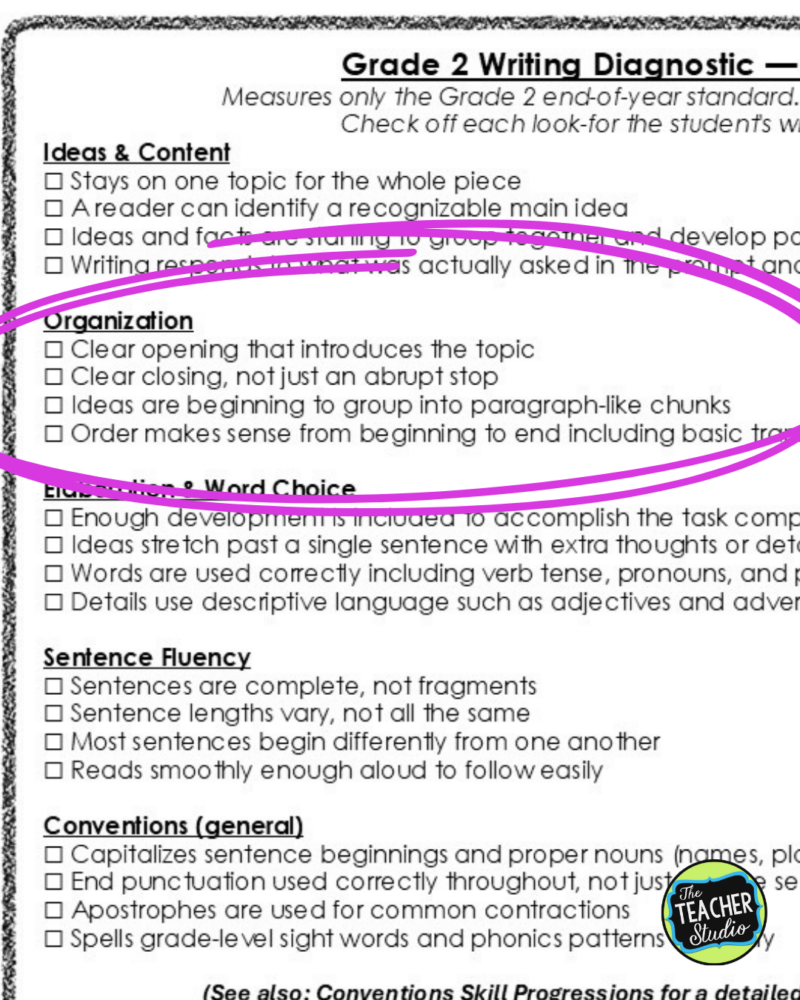
If you’re like me, a writing grade is something teachers HAVE to do a few times a year. The REAL job of writing assessment is to guide your instruction!
So What Actually Helps?
If a writing assessment doesn’t leave you knowing exactly what to teach next, it isn’t doing its job. That’s the whole idea behind checklist-based and rubric-based writing assessment instead of a single score. It shows you exactly which skills are already there and which aren’t. This is the information a teacher can actually act on during those precious planning times.

This requires a shared, grade-by-grade definition of what each piece actually looks like. That’s not something most teachers have time to build from scratch, especially not across every grade level at once.
That’s exactly what my Elementary Writing Assessment System was built to solve. It scores the traits and the conventions side by side, so neither one quietly outweighs the other, and it’s built on a continuum that already defines what each skill looks like from grade 1 through grade 5, so the vertical alignment work is already done.
But whether you ever use this particular tool or not, the goal underneath it is one every classroom already shares–know your writers well enough to teach them well. I hope this gave you a clearer way to think about how to get there.
Do you follow me on social media yet? I’d love to connect there!