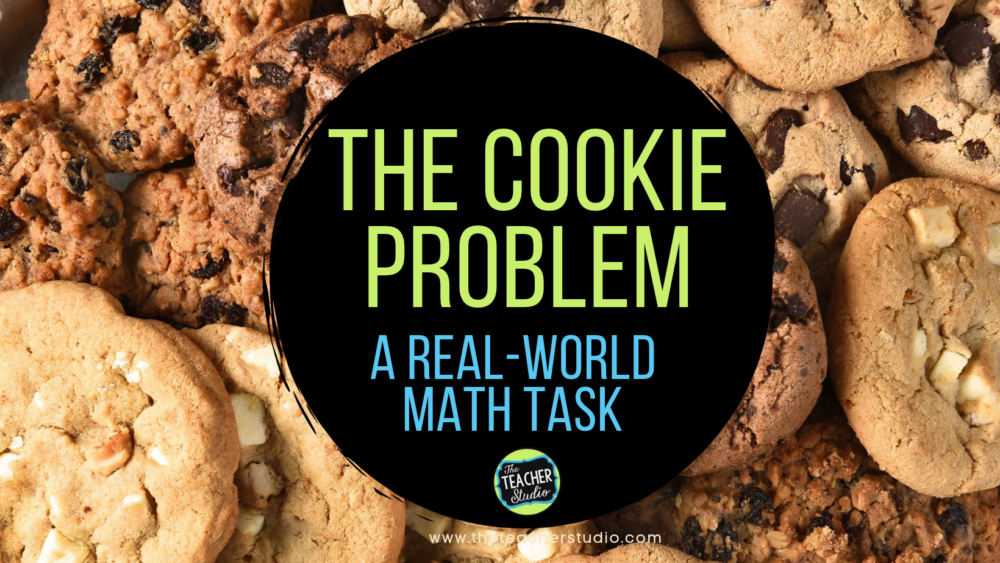
Well, after the fun of “The Doorbell Rang”, I thought it might be kind of fun to continue with our cookie studies! I asked a few families if they would be willing to donate a bag of cookies to the class and two rose to the occasion. I wasn’t QUITE sure what I was going to do with them, but I knew the kids would love using food as a motivator–we don’t do it too often!
I hadn’t put much thought into this, so I didn’t plan for a huge long ordeal. I thought we’d get the cookies, split them up, and move on.

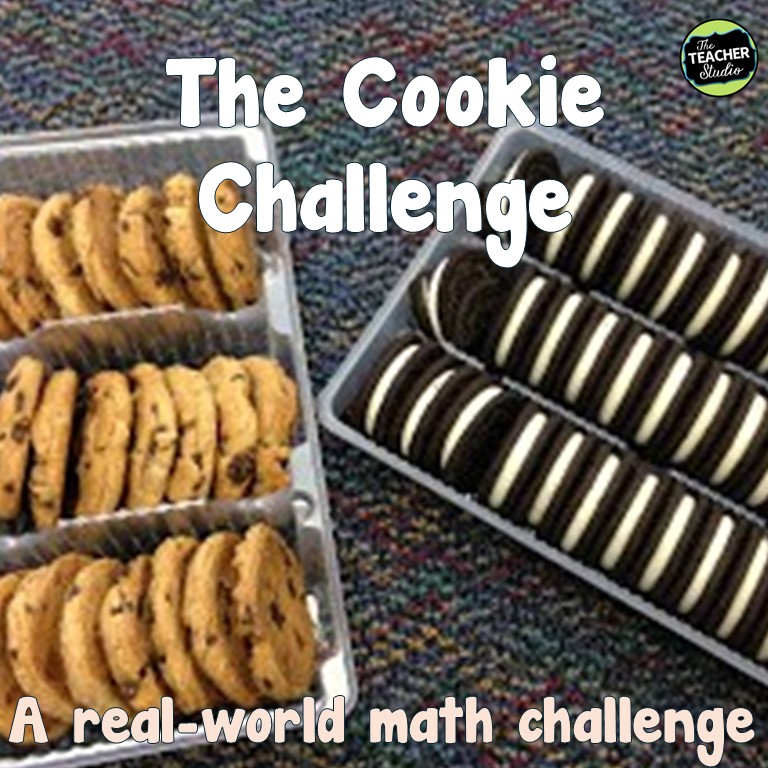
However, when I got the two packages in, I turned them over and groaned. Why? Package one had “about 20 servings” of 1 cookie. Package two had “about 20 servings of 2 cookies”. Really? I HAVE 22 STUDENTS! What was I supposed to do “division-wise” with THAT?
I decided to move forward and see where it took us. I typed up a quick journal problem presenting the above information and asking the following two questions:
Let’s Get Started!
The students got to work and I saw everything from blank pages to “good tries”. Finally one student hopped up and grabbed some counters.

A few more followed suit and soon the room was humming. I did have to stop the class to troubleshoot one thing–the students didn’t understand the concept of “serving size”, so THAT was getting in the way for some of them!
Kids worked together and, for the most part, were able to come up with some sort of a solution that seemed reasonable. Again, with only having “about” 60 cookies, there weren’t a lot of solution options–or so I thought!

Until a student said, “HEY! The package said there were “about” 20 servings. What if there aren’t?”
Chaos erupts and chants of “OPEN THEM! OPEN THEM!” rang out. So I did.

The Findings
And what did we learn? One package had 3 rows of 7 and the other had 3 rows of 13! We were all predicting a pack of twenty and a pack of 40! Students rushed back to their notebooks to see how this might change their solutions. We did some sharing of ideas, and then I had a decision to make. We had all agreed that each student could have 2 full cookies and at least 1/2 of another one. Were we done? Or should I take it further.
Guess what I picked?
I pulled the students in around the cookies and slowly said, “I think we have a problem.” I was all set to explain that we only have 21 chocolate chip cookies and 22 students when someone chimed out, “We aren’t all going to be able to have the same cookies.”
And thus began the next stage of the problem! I asked, “How in the world are we going to decide who gets what cookies?” I sent them back to their teams to brainstorm. When we came back together, we came to the conclusion that we could collect some data to learn what cookies everyone wanted–and then we could see if we had enough to do it. So I asked,
“Which would you rather have–Oreos or Chips Ahoy?” and the results were in:
And then I heard, “Wait! That adds up to more than 22!” and “Hey! I didn’t know I could vote for BOTH!” and I laughed. I told them that I didn’t ask the right question–so we worked to come up with a better set of choices. I also clarified that we would NOT be breaking cookies in half–that everyone could have 2 WHOLE cookies. Here were our NEW findings!

Back to Work
I then sent the students back to their teams to use our data to see if it was possible to give everyone what they wanted. I reminded them that we have 21 Chips Ahoy and 39 Oreos. The kids dashed back to work and you seriously could hear a pin drop for 5 minutes. Finally one voice called out, “I think we can do it!!!!” and the sharing began.
After a while, I had several different groups come up and try to “prove” that we could indeed execute the plan, and they did some really nice explaining. They explained that we needed 4 Oreos for the “only Oreo” people, 4 Chips Ahoy for the “only Chips Ahoy” people, and 13 of each type for the “both” people–leaving lots of options for our “Don’t Care” kids.
You know where this is going, right?
“So . . . before you can have your cookies–let’s figure out ALL the options for our “don’t care” kids!
And so they did! Again, today was supposed to be a quick division exploration and ended up being an 80 minute multiplication, division, data collection, analysis lesson. We had a BLAST! And, most importantly, if YOU do the math, you will realize that 22 students x 2 cookies is WAY less than the actual number of cookies in the packages.
Try It in Your Class
Want to try this with your own students? You don’t need anything fancy. Pick up a package or two of cookies, check the “servings” line on the back, and adjust the numbers to match your class. The fun part is that the packages rarely match the label, so the “what if there aren’t really 20?” moment tends to happen on its own.
Here are the two questions I used:
- Knowing that there are ___ students in the class, what is your recommendation for sharing?
- What if there were 12 students in the class? What would be your recommendation for sharing?
A few things I learned along the way:
- Make sure students understand “serving size” before they start. That one term tripped up more kids than the division did.
- Put counters out where kids can reach them, but don’t tell them to use them. Watch who grabs them first.
- Leave room to keep going. When my students noticed the packages didn’t match the label, I followed their lead, and that’s where the best math happened.
Want the questions ready to print? Get the free Cookie Math recording page HERE or by clicking the image below. You can have your students solve MY problem, or you can put your own class numbers in and get your own cookies!
As for me, I’ve wiped the crumbs off my computer. No worries.
Want to check out more “real world” problem-solving ideas? THIS POST can help! Want to read about another engaging division lesson? HERE YOU GO!
Do you follow me on social media yet? I'd love to connect there!
Facebook
TikTok
Instagram
Youtube
Or sign up for my email list RIGHT HERE for freebies, teaching tips, and more!