Day 4 Fractions: Example and Counterexample…Building Fraction Sense
In math class, fraction examples and counterexamples are one of my favorite ways to help students really think about what’s true—and why. An example shows a statement that works, while a counterexample shows a case that almost works but actually doesn’t. Those “almost” cases are where the real learning happens.
When students are asked to decide whether something is an example or a counterexample, they have to slow down, talk through their thinking, and pay attention to the details that matter. This kind of work naturally surfaces misconceptions and leads to rich math talk, especially during fraction lessons where students are still sorting out what fractions really represent.
Fraction Warm Up Problem
Our “fractionfest” continued Friday by taking our investigations a little deeper. We started our day by checking our their homework–how they divided the 5 x 5 grid into halves. I asked students who thought they had interesting explanations to share on the document camera.
Sorry so blurry! I was so excited about the math talk that my photos weren’t great in the dim light of the white board!
We had all sorts of fun talking about refining our “math talk” so that anyone would be able to clearly understand our ideas. This is REALLY hard for my students, so I must remember to work in more modeling for them!
What Are Fraction Example and Counterexample Activities?
In math class, examples and counterexamples are one of my favorite ways to help students really think about what’s true—and why. An example shows a statement that works, while a counterexample shows a case that almost works but actually doesn’t. Those “almost” cases are where the real learning happens.
When students are asked to decide whether something is an example or a counterexample, they have to slow down, talk through their thinking, and pay attention to the details that matter. This kind of work naturally surfaces misconceptions and leads to rich math talk, especially during fraction lessons where students are still sorting out what fractions really represent.
So..where did we head next?
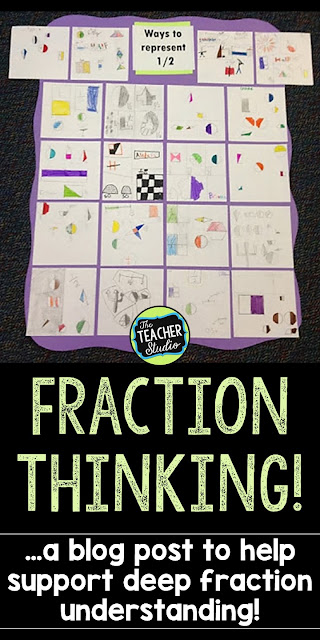
I warmed us up with something easy-ish. We set out to really refine our thinking about what “1/2” really means. I asked students to take a little time to make a mini poster (a common learning strategy in our room) to show me “5 ways to represent 1/2”. Represent is one of those words we try to use a lot–to make sure they understand how we can use word, numbers, symbols, and drawings to represent our thinking.
Today I asked them to really think outside the box and come up with 5 DIFFERENT ways to represent 1/2. I wandered around looking at their ideas, hoping to get some information about where to head next in this unit. I noticed that most students were representing 1/2 by drawing different shapes (“wholes”) and dividing into two equal pieces. There are so many more ways to represent fractions, so I need to find ways to get them exposed to them in the coming weeks.
Teaching Fraction Thinking
So what next?
After this, I felt it was time to review a skill we have dabbled in all year–creating those examples and counterexamples. I split the class into groups and assigned each a fractional part–thirds, fourths, and so on. Each team was then responsible for designing a learning poster that represented their fractional part. This time they needed to include five fraction EXAMPLES and one COUNTEREXAMPLE. I told them that their job was to create a poster that we would share. Then, the other groups would need to analyze their examples and find out which representation was the COUNTEREXAMPLE.
The students had a BLAST trying to find ways to subtly “trick” their classmates with their fraction examples and counterexamples! They had great discussions about what would make a representation accurate or inaccurate, what common misconceptions might trick their classmates, and really pushed each other to do accurate work. We ran out of time to share, so I’ll have to report back next week!
Want some great fraction freebies to help you dig in?
This blog post is now a part of my comprehensive fraction unit available by clicking the image below. Literally THOUSANDS of teachers have now used it to change the way they teach fractions!
Because my fraction resources have gotten so popular, I’ve also made a bundle of 12 of the most sought-after ones at a discounted price. You can grab that bundle by clicking HERE or the image below.
Did you miss Day 1, Day 2, or Day 3 of this fraction series?
you can also sign up for my NEWSLETTER where I start you off with an awesome freebie–and then you will get even more teaching tips, freebies, and offers delivered right to your mailbox!